
In 2021, a post on an obscure forum called Agora Road’s Macintosh Cafe put a name to a feeling plenty of people already had: that the internet had gone hollow. The theory said most of what you see online is made by bots, for bots, and that the real people had quietly left the room. They called it the dead internet theory.
For years it was filed under conspiracy. Then in September 2025, Sam Altman, the CEO of the company behind ChatGPT, posted that he had never taken the dead internet theory seriously, but that there now seemed to be a lot of LLM-run accounts on Twitter. When the person who built the most popular chatbot starts noticing, it is fair to ask how much of the theory has come true.
Is the dead internet theory true?
Not in its strongest form. Billions of people are still online, writing, filming and arguing. But the parts of the theory you can measure are all moving in its direction, and generative AI is the main reason.
- Most web traffic is no longer human. Imperva’s 2025 Bad Bot Report found automated traffic made up 51 per cent of all web traffic in 2024, overtaking humans for the first time in a decade. Malicious bots alone were 37 per cent, up from 32 per cent the year before, and the report puts the rise down largely to AI making bots cheap to build.
- About half of new articles are written by AI. SEO firm Graphite sampled articles from Common Crawl and found AI-generated articles overtook human-written ones in November 2024. Before ChatGPT launched, the share was around 5 per cent. Its updated analysis this year found the share has hovered near half ever since.
- Most new pages have some AI in them. Ahrefs analysed 900,000 new web pages in April 2025 and found 74 per cent contained AI-generated content. Only about a quarter were purely human.
- Fewer people reach the humans who still write. Pew Research tracked the browsing of 900 US adults and found that when Google showed an AI Overview, people clicked a regular result in 8 per cent of visits, against 15 per cent without one. They clicked a source inside the summary just 1 per cent of the time, and were more likely to end their session right there.
Put those together and you get the loop researchers worry about. AI writes more of the web. AI summaries stop people visiting the humans who still write it. Then the next generation of models trains on a web with less human writing in it. A 2024 paper in Nature showed what happens when models learn from their own output over successive generations: they gradually lose the rarer, more interesting parts of what they knew, and their answers converge on a bland average. Researchers call it model collapse.
AI detection is imperfect and each of these studies has caveats. The direction of travel is not really in doubt.
So who decides what you read now?
There is a twist in Graphite’s data. Even with half of new articles written by AI, around 86 per cent of top-ranking Google results were human-written, and AI-written pages rarely surfaced in ChatGPT answers either. The answer engines are already filtering out a lot of the slop.
That is partly good news. But it means curation is happening anyway, just inside a ranking system or a model you cannot see, tuned for the average person asking that question on that day. You don’t choose whose voice makes the cut. Ask the same question next month and you might get different sources, or none named at all.
The real problem with the dead internet is not that there is too much AI content. It is that you are no longer the one choosing what to trust.
Curation is the antidote
The fix is an old one. Before search engines, people found good information through other people: the critic whose taste they shared, the newsletter they forwarded, the friend who actually knew about cars, the one forum that had the real answers. Curation by trusted humans is how good information survived every previous flood, from cheap printing to content farms.
It works the same way now, if you do it deliberately:
- Follow people, not feeds. A creator who has tested cameras for ten years is a better filter than any ranking algorithm.
- Keep the source, not just the takeaway. If you know where something came from, you can judge it, and go back to it.
- Choose once, use often. Deciding what you trust should not have to happen again every time you open a new chat.
The catch: your curation never reaches your AI
Most people already curate. They have creators they follow, posts they have saved, newsletters they read, a bookmarks folder they rarely open. The problem is that none of it shows up where they now ask their questions.
Ask ChatGPT, Claude or Google’s AI Overview how to handle your first 90 days in a new role, and it answers from whatever it was trained on, or whatever its search turned up that afternoon. The product manager whose videos you have watched for three years is not in the room, unless you go and find the video, copy the transcript and paste it in. Nobody does that every time. So the AI falls back on the averaged-out web, which is exactly the web the dead internet theory describes.
Curation only counts if it reaches the place you actually get your answers.
How Kepler puts your curation inside ChatGPT and Claude
Kepler turns the parts of the internet you choose into context your AI can use. There are three ways to build it.
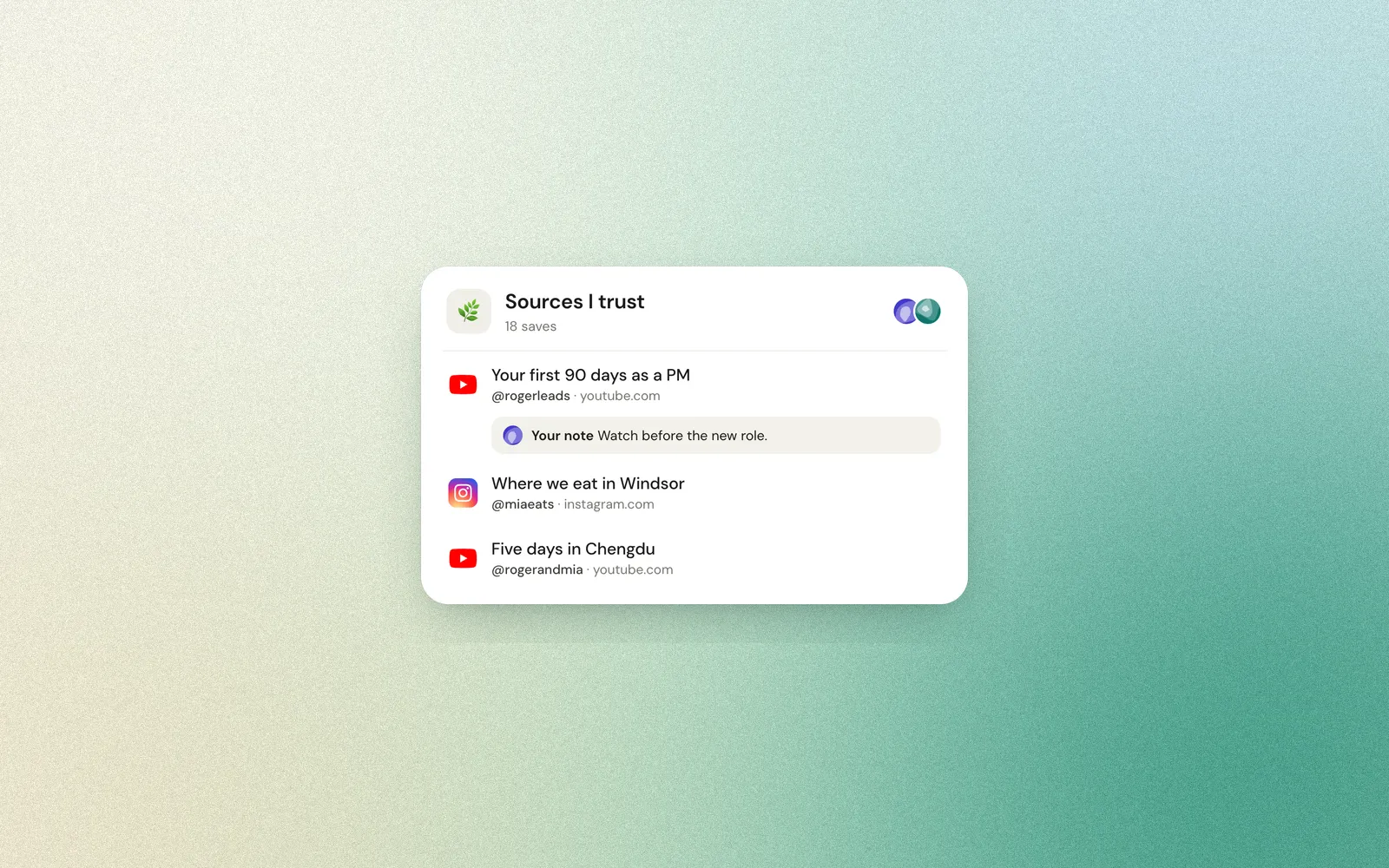
Curate your own sources. Save the articles, videos, posts and threads you trust into a space as you come across them, from your browser or your phone, with a note on why each one mattered. Kepler keeps what is inside each save, from the transcript to the key points, not just the link.
Connect to your creators’ spaces. Creators can bring their YouTube videos, TikToks and Substack posts into one Kepler space and share it as a view, with a single link for their bio. Followers can browse it and ask it questions, or bring it into ChatGPT and Claude through Kepler, so the answer comes from what that creator actually made. Ask how @rogerleads runs a one-on-one and you get his approach, with the video and post it came from. See how Kepler works for creators.
Create a space that mixes both. Combine the creators you trust with your own saves and notes for a trip, a project or something you are learning, and share it with the people you are doing it with.
Then connect Kepler to ChatGPT or Claude over MCP, the open standard for giving AI outside context. When you ask a question, your AI searches the spaces you point it at and shows which save each point came from. It is the same idea behind bringing your own sources to Claude, applied to the people you trust.
Your internet, not today’s internet
The difference comes down to who chooses. Without curation, ChatGPT and Claude answer from whatever the web serves them that day: a web where half the new writing is machine-made and most of the traffic is bots. With it, they answer from the corner of the internet you decided was worth trusting: the creators you follow, the sources you checked, the notes you wrote.
The internet isn’t dead. The people are still there; they are just harder to find in the noise. Curation is how you find them once and keep them. Kepler is how you put them in front of your AI every time you ask.
Start your first space → and choose which internet your AI answers from.
Kepler helps you create context for AI from the links you save. It improves the AI tools you already use. It isn’t one itself.
Sources
- TIME, What to Know About the “Dead Internet” Theory, and Why It’s Spreading (September 2025)
- Futurism, Sam Altman Says He’s Suddenly Worried Dead Internet Theory Is Coming True (September 2025): futurism.com/sam-altman-dead-internet-theory
- Imperva (Thales), 2025 Bad Bot Report, via ITPro: itpro.com/security/ai-is-helping-bad-bots-take-over-the-internet
- Graphite, More Articles Are Now Created by AI Than Humans (2025), via eWeek: eweek.com/news/ai-writes-half-internet
- Axios, AI hasn’t overtaken human writers online (May 2026): axios.com/2026/05/15/human-vs-ai-written-articles
- Ahrefs, 74% of New Webpages Include AI Content (Study of 900k Pages) (May 2025): ahrefs.com/blog/what-percentage-of-new-content-is-ai-generated
- Pew Research Center, Google users are less likely to click on links when an AI summary appears in the results (July 2025): pewresearch.org
- Shumailov et al., AI models collapse when trained on recursively generated data, Nature (July 2024): nature.com/articles/s41586-024-07566-y